Getting Started
Agent configuration, learning path, prompting skills, and organizational readiness for agentic continuous delivery.
6 minute read
Agentic continuous delivery (ACD) defines the additional constraints and artifacts needed when AI agents contribute to the delivery pipeline. The pipeline must handle agent-generated work with the same rigor applied to human-generated work, and in some cases, more rigor. These constraints assume the team already practices continuous delivery. Without that foundation, the agentic extensions have nothing to extend.
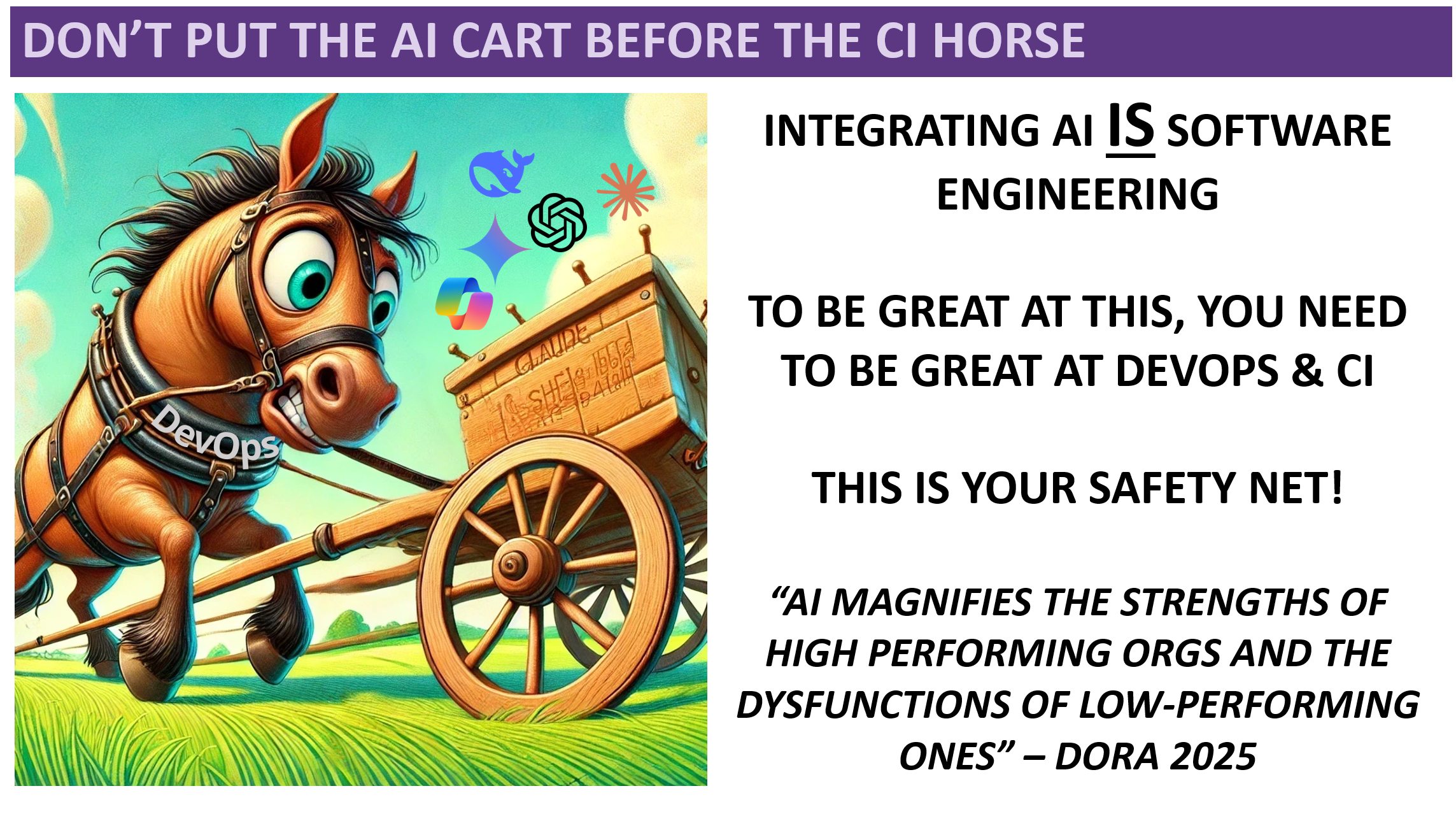
An agent-generated change must meet or exceed the same quality bar as a human-generated change. The pipeline does not care who wrote the code. It cares whether the code is correct, tested, and safe to deploy.
ACD is the application of continuous delivery in environments where software changes are proposed by agents. It exists to reliably constrain agent autonomy without slowing delivery.
Without additional artifacts beyond what human-driven CD requires, agent-generated code accumulates drift and technical debt faster than teams can detect it. The delivery artifacts and constraints in the agent delivery contract address this.
Agents introduce unique challenges that require these additional constraints:
Before jumping into agentic workflows, ensure your team has the prerequisite delivery practices in place. The AI Adoption Roadmap provides a step-by-step sequence: quality tools, clear requirements, hardened guardrails, and reduced delivery friction, all before accelerating with AI coding. The Learning Curve describes how developers naturally progress from autocomplete to a multi-agent architecture and what drives each transition.
ACD extends continuous delivery. These practices must be working before agents can safely contribute:
Without these foundations, adding agents amplifies existing problems rather than accelerating delivery.
ACD extends MinimumCD by the following constraints:
These constraints are not mandatory practices. They describe the minimum conditions required to sustain delivery pace once agents are making changes to the system.
Every ACD change is anchored by agent delivery contract - structured documents that define intent, behavior, constraints, acceptance criteria, and system-level rules. Agents may read and generate artifacts. Agents may not redefine the authority of any artifact. Humans own the accountability.
See Agent Delivery Contract for the authority hierarchy, detailed definitions, and examples.
Humans own the specifications. Agents collaborate during specification and own test generation and implementation. The pipeline enforces correctness. At every specification stage, the four-step cycle applies: human drafts, agent critiques, human decides, agent refines.
| Stage | Human | Agent | Pipeline |
|---|---|---|---|
| Intent Description | Draft and own the problem statement and hypothesis | Find ambiguity, suggest edge cases, sharpen hypothesis | |
| User-Facing Behavior | Define and approve BDD scenarios | Generate scenario drafts, find gaps and weak scenarios | |
| Feature Description | Set constraints and architectural boundaries | Suggest architectural considerations and integration points | |
| Acceptance Criteria | Define thresholds and evaluation design | Draft non-functional criteria, check cross-artifact consistency | |
| Specification Validation | Gate before implementation begins | Review all four artifacts for conflicts, gaps, and ambiguity | |
| Test Generation | Generate test code from BDD scenarios, feature description, and acceptance criteria | ||
| Test Validation | Review (interim) | Expert validation agents progressively replace human review | |
| Implementation | Generate production code within one small-batch session per scenario | ||
| Pipeline Verification | Run all tests; all scenarios implemented so far must pass | ||
| Code Review | Review (interim) | Expert validation agents progressively replace human review | |
| Deployment | Deploy through the same pipeline as any other change |
Human review at Test Validation and Code Review is an interim state. Replace it using the same replacement cycle used throughout the CD migration. See Pipeline Enforcement for the full set of expert agents and how to adopt them.
Content contributed by Michael Kusters and Bryan Finster. Image contributed by Scott Prugh.
Agent configuration, learning path, prompting skills, and organizational readiness for agentic continuous delivery.
The delivery artifacts that define intent, behavior, and constraints for agent-generated changes - framed as hypotheses so each change validates whether it achieved its purpose.
Multi-agent design patterns, coding and review setup, and session structure for agent-generated work.
Pipeline enforcement, token cost management, and metrics for sustaining agentic continuous delivery.