The Agentic Development Learning Curve
12 minute read
Many developers using AI coding tools today are at Stage 1 or Stage 2. Many conclude from that experience that AI is only useful for boilerplate, or that it cannot handle real work. That conclusion is not wrong given their experience - it is wrong about the ceiling. The ceiling they hit is the ceiling of that stage, not of AI-assisted development. Every stage above has a higher ceiling, but the path up is not obvious without exposure to better practices.
The progression below describes the stages developers generally experience when learning AI-assisted development. At each stage, a specific bottleneck limits how much value AI actually delivers. Solving that constraint opens the next stage. Ignoring it means productivity gains plateau - or reverse - and developers conclude AI is not worth the effort.
Progress through these stages does not happen naturally or automatically. It requires intentional practice changes and, most importantly, exposure to what the next stage looks like. Many developers never see Stages 4 through 6 demonstrated. They optimize within the stage they are at and assume that is the limit of the technology.
Stage 1: Autocomplete
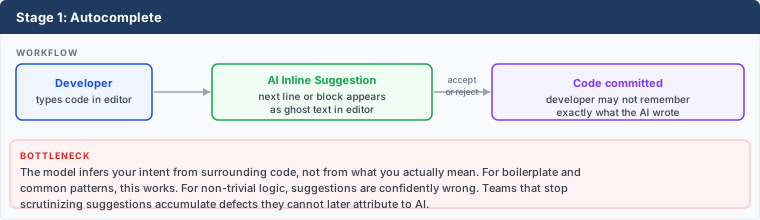
What it looks like: AI suggests the next line or block of code as you type. You accept, reject, or modify the suggestion and keep typing. GitHub Copilot tab completion, Cursor tab, and similar tools operate in this mode.
Where it breaks down: Suggestions are generated from context the model infers, not from what you intend. For non-trivial logic, suggestions are plausible-looking but wrong - they compile, pass surface review, and fail at runtime or in edge cases. Teams that stop reviewing suggestions carefully discover this months later when debugging code they do not remember writing.
What works: Low friction, no context management, passive. Excellent for boilerplate, repetitive patterns, argument completion, and common idioms. Speed gains are real, especially for code that follows well-known patterns.
Why developers stay here: The gains at Stage 1 are real and visible. Autocomplete is faster than typing, requires no workflow change, and integrates invisibly into existing habits. There is no obvious failure that signals a ceiling has been hit - developers just accept that AI is useful for simple things and not for complex ones. Without seeing what Stage 4 or Stage 5 looks like, there is no reason to assume a better approach exists.
What drives the move forward: Deliberate curiosity, or an incident traced to an accepted suggestion the developer did not scrutinize. Developers who move forward are usually ones who encountered a demonstration of a higher stage and wanted to replicate it - not ones who naturally outgrew autocomplete.
Stage 2: Prompted Function Generation
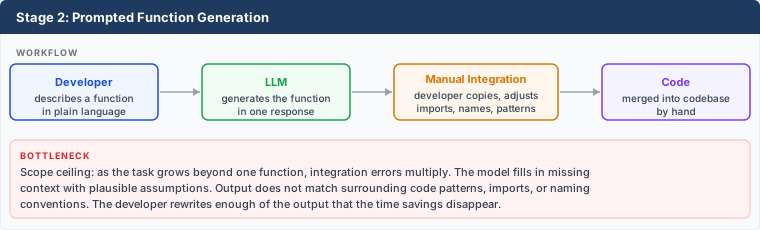
What it looks like: The developer describes what a function or module should do, pastes the description into a chat interface, and integrates the result. This is single-turn: one request, one response, manual integration.
Where it breaks down: Scope creep. As requests grow beyond a single function, integration errors accumulate: the generated code does not match the surrounding codebase’s patterns, imports are wrong, naming conflicts emerge. The developer rewrites more than half the output and the AI saved little time. Larger requests also produce confidently incorrect code - the model cannot ask clarifying questions, so it fills in assumptions.
What works: Bounded, well-scoped tasks with clear inputs and outputs. Writing a parser, formatting utility, or data transformation that can be fully described in a few sentences. The developer reviews a self-contained unit of work.
Why developers abandon here: Stage 2 is where many developers decide AI “cannot write real code.” They try a larger task, receive confidently wrong output, spend an hour correcting it, and conclude the tool is not worth the effort for anything non-trivial. That conclusion is accurate at Stage 2. The problem is not the technology - it is the workflow. A single-turn prompt with no context, no surrounding code, and no specified constraints will produce plausible-looking guesses for anything beyond simple functions. Developers who abandon here never discover that the same model, given different inputs through a different workflow, produces dramatically better output.
What drives the move forward: Frustration that AI is only useful for small tasks, combined with exposure to someone using it for larger ones. The realization that giving the AI more context - the surrounding files, the calling code, the data structures - would produce better output. This realization is the entry point to context engineering.
Stage 3: Chat-Driven Development
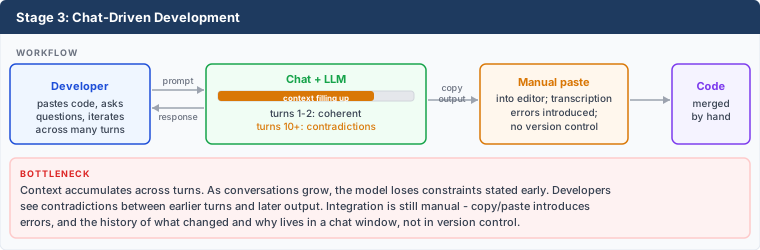
What it looks like: Multi-turn back-and-forth with the model. Developer pastes relevant code, describes the problem, asks for changes, reviews output, pastes it back with follow-up questions. The conversation itself becomes the working context.
Where it breaks down: Context accumulates. Long conversations degrade model performance as the relevant information gets buried. The model loses track of constraints stated early in the conversation. Developers start seeing contradictions between what the model said in turn 3 and what it generates in turn 15. Integration is still manual - copying from chat into the editor introduces transcription errors. The history of what changed and why lives in a chat window, not in version control.
What works: Exploration and learning. Asking “why does this fail” with a stack trace and getting a diagnosis. Iterating on a design by discussing trade-offs. For developers learning a new framework or language, this stage can be transformative.
What drives the move forward: The integration overhead and context degradation become obvious. Developers want the AI to work directly in the codebase, not through a chat buffer.
Stage 4: Agentic Task Completion
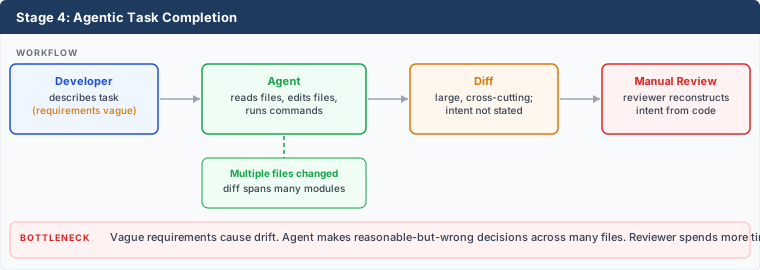
What it looks like: The agent has tool access - it reads files, edits files, runs commands, and works across the codebase autonomously. The developer describes a task and the agent executes it, producing diffs across multiple files.
Where it breaks down: Vague requirements. An agent given a fuzzy description makes reasonable-but-wrong architectural decisions, names things inconsistently, misses edge cases it cannot infer from the existing code, and produces changes that look correct locally but break something upstream. Review becomes hard because the diff spans many files and the reviewer must reconstruct the intent from the code rather than from a stated specification. Hallucinated APIs, missing error handling, and subtle correctness errors compound because each small decision compounds on the next.
What works: Larger-scoped tasks with clear intent. Refactoring a module to match a new interface, generating tests for existing code, migrating a dependency. The agent navigates the codebase rather than receiving pasted excerpts.
What drives the move forward: Review burden. The developer spends more time validating the agent’s output than they would have spent writing the code. The insight that emerges: the agent needs the same thing a new team member needs - explicit requirements, not vague descriptions.
Stage 5: Spec-First Agentic Development
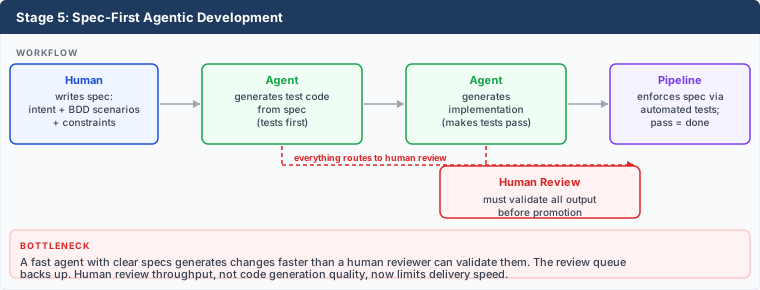
What it looks like: The developer writes a specification before the agent writes any code. The specification includes intent (why), behavior scenarios (what users experience), and constraints (performance budgets, architectural boundaries, edge case handling). The agent generates test code from the specification first. Tests pass when the behavior is correct. Implementation follows. The Agent Delivery Contract defines the artifact structure. Agent-Assisted Specification describes how to produce specifications at a pace that does not bottleneck the development cycle.
Where it breaks down: Review volume. A fast agent with a spec-first workflow generates changes faster than a human reviewer can validate them. The bottleneck shifts from code generation quality to human review throughput. The developer is now a reviewer of machine output, which is not where they deliver the most value.
What works: Outcomes become predictable. The agent has bounded, unambiguous requirements. Tests make failures deterministic rather than subjective. Code review focuses on whether the implementation is reasonable, not on reconstructing what the developer meant. The specification becomes the record of why a change exists.
What drives the move forward: The review queue. Agents generate changes at a pace that exceeds human review bandwidth. The next stage is not about the developer working harder - it is about replacing the human at the review stages that do not require human judgment.
Stage 6: Multi-Agent Architecture
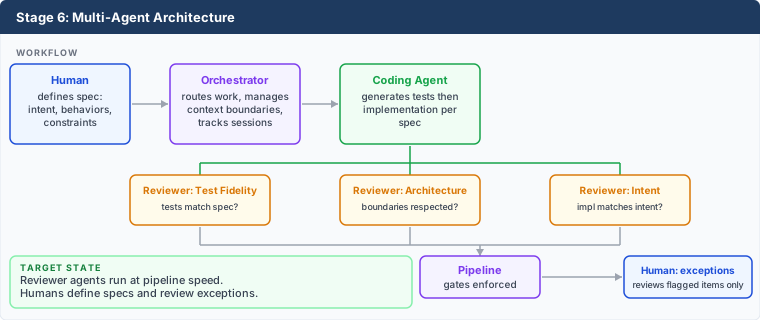
What it looks like: Separate specialized agents handle distinct stages of the workflow. A coding agent implements behavior from specifications. Reviewer agents run in parallel to validate test fidelity, architectural conformance, and intent alignment. An orchestrator routes work and manages context boundaries. Humans define specifications and review what agents flag - they do not review every generated line.
What works: The throughput constraint from Stage 5 is resolved. Expert review agents run at pipeline speed, not human reading speed. Each agent is optimized for its task - the reviewer agents receive only the artifacts relevant to their review, keeping context small and costs bounded. Token costs are an architectural concern, not a billing surprise.
What the architecture requires:
- Explicit, machine-readable specifications that agent reviewers can validate against
- Structured inter-agent communication (not prose) so outputs transfer efficiently
- Model routing by task: smaller models for classification and routing, frontier models for complex reasoning
- Per-workflow token cost measurement, not per-call measurement
- A pipeline that can run multiple agents in parallel and collect results before promotion
- Human ownership of specifications - the stages that require judgment about what matters to the business
This is the ACD destination. The ACD workflow defines the complete sequence. The agent delivery contract are the structured documents the workflow runs on. Tokenomics covers how to architect agents to keep costs in proportion to value. Coding & Review Setup shows a recommended orchestrator, coder, and reviewer configuration.
Why Progress Stalls
Many developers do not advance past Stage 2 because the path forward is not visible from within Stage 1 or 2. The information gap is the dominant constraint, not motivation or skill.
The problem at Stage 1: Autocomplete delivers real, immediate value. There is no pressing failure, no visible ceiling, no obvious reason to change the workflow. Developers optimize their Stage 1 usage - learning which suggestions to trust, which to skip - and reach a stable equilibrium. That equilibrium is far below what is possible.
The problem at Stage 2: The first serious failure at Stage 2 - an hour spent correcting hallucinated output - produces a lasting conclusion: AI is only for simple things. This conclusion comes from a single data point that is entirely valid for that workflow. The developer does not know the problem is the workflow.
The problem at Stages 3-4: Developers who push past Stage 2 often hit Stage 3 or 4 and run into context degradation or vague-requirements drift. Without spec-first discipline, agentic task completion produces hard-to-review diffs and subtle correctness errors. The failure mode looks like “AI makes more work than it saves” - which is true for that approach. Many developers loop back to Stage 2 and conclude they are not missing much.
What breaks the pattern: Seeing a demonstration of Stage 5 or Stage 6 in practice. Watching someone write a specification, have an agent generate tests from it, implement against those tests, and commit a clean diff is a qualitatively different experience from struggling with a chat window. Many developers have not seen this. Most resources on “how to use AI for coding” describe Stage 2 or Stage 3 workflows.
This guide exists to close that gap. The four prompting disciplines describe the skill layers that correspond to these stages and what shifts when agents run autonomously.
How the Bottleneck Shifts Across Stages
| Stage | Where value is generated | What limits it |
|---|---|---|
| Autocomplete | Boilerplate speed | Model cannot infer intent for complex logic |
| Function generation | Self-contained tasks | Manual integration; scope ceiling |
| Chat-driven development | Exploration, diagnosis | Context degradation; manual integration |
| Agentic task completion | Multi-file execution | Vague requirements cause drift; review is hard |
| Spec-first agentic | Predictable, testable output | Human review cannot keep up with generation rate |
| Multi-agent architecture | Full pipeline throughput | Specification quality; agent orchestration design |
Each stage resolves the previous stage’s bottleneck and reveals the next one. Developers who skip stages - for example, moving straight from function generation to multi-agent architecture without spec-first discipline - find that automation amplifies the problems they skipped. An agent generating changes faster than specs can be written, or a reviewer agent validating against specifications that were never written, produces worse outcomes than a slower, more manual process. Skipping is tempting because the later tooling looks impressive. It does not work without the earlier discipline.
Starting from Where You Are
Three questions locate you on the curve:
- What does agent output require before it can be committed? Minimal cleanup (Stage 1-2), significant rework (Stage 3-4), or the pipeline decides (Stage 5-6)?
- Does every agent task start from a written specification? If not, you are at Stage 4 or below regardless of what tools you use.
- Who reviews agent-generated changes? If the answer is always a human reading every diff, you have not yet addressed the Stage 5 throughput ceiling.
Many developers using AI coding tools are at Stage 1 or 2. Many concluded from an early Stage 2 failure that the ceiling is low and moved on. If you are at Stage 1 or 2 and feel like AI is only useful for simple work, the problem is almost certainly the workflow, not the technology.
If you are at Stage 1 or 2: The highest-leverage move is hands-on exposure to an agentic tool at Stage 4. Give the agent access to your codebase - let it read files, run tests, and produce a diff for a small task. The experience of watching an agent navigate a codebase is qualitatively different from receiving function output in a chat window. See Small-Batch Sessions for how to structure small, low-risk tasks that demonstrate what is possible without exposing the full codebase to an unguided agent.
If you are at Stage 3 or 4: The highest-leverage move is writing a specification before giving any task to an agent. One paragraph describing intent, one scenario describing the expected behavior, and one constraint listing what must not change. Even an informal spec at this level produces dramatically better output and easier review than a vague task description.
If you are at Stage 5: Measure your review queue. If agent-generated changes accumulate faster than they are reviewed, you have hit the throughput ceiling. Expert reviewer agents are the next step.
The AI Adoption Roadmap covers the organizational prerequisites that must be in place before accelerating through the later stages. The curve above describes an individual developer’s progression; the roadmap describes what the team and pipeline need to support it.
Related Content
- The Four Prompting Disciplines - the skill layers that map to each stage of the learning curve
- AI Adoption Roadmap - organizational prerequisites for the later stages
- ACD - the full workflow, constraints, and delivery artifacts
- Agent-Assisted Specification - how to write specs fast enough that they do not slow down Stage 5
- Agent Delivery Contract - the documents the multi-agent workflow depends on
- Tokenomics - how to architect Stage 6 so token costs scale with value
- Coding & Review Setup - a concrete Stage 6 configuration
- Small-Batch Sessions - how to keep agent context small at every stage
- Pipeline Enforcement and Expert Agents - how review agents replace manual validation at Stage 6
Content contributed by Bryan Finster