Test Architecture
9 minute read
A test architecture that lets your pipeline deploy confidently, regardless of external system availability, is a core CD capability. The Test Types pages cover each type in depth.
A CD pipeline’s job is to force every artifact to prove it is worthy of delivery. That proof only works when test changes ship with the code they validate. If a developer adds a feature but the corresponding tests arrive in a later commit, the pipeline approved an artifact it never actually verified. That is not a CD pipeline. It is a CI pipeline with a deploy step. Tests and production code must always travel together through the pipeline as a single unit of change.
Beyond the Test Pyramid

The test pyramid says: write many fast unit tests at the base, fewer integration tests in the middle, and only a handful of end-to-end tests at the top. The underlying principle is sound - lower-level tests are faster, more deterministic, and cheaper to maintain.
The principle behind the shape
The pyramid’s shape communicates a principle: prefer fast, deterministic tests that you fully control. Tests at the base are cheap to write, fast to run, and reliable. Tests at the top are slow, expensive, and depend on systems outside your control. The more weight you put at the base, the faster and more reliable your pipeline becomes - to a point. We also have the engineering goal of achieving the most functional coverage with the fewest number of tests. Every test costs money to maintain and adds time to the pipeline.
The testing trophy
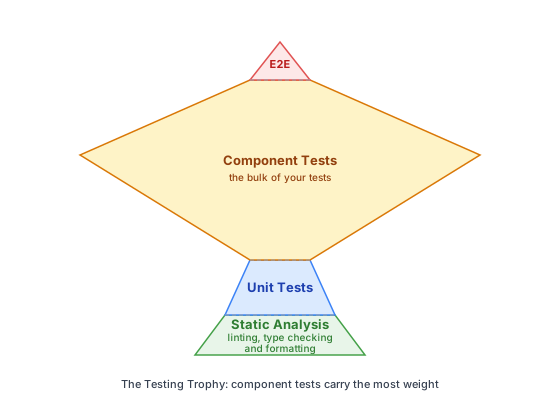
The testing trophy, popularized by Kent C. Dodds, rebalances the pyramid by putting component tests at the center. Where the pyramid emphasizes unit tests at the base, the trophy argues that component tests give you the most confidence per test because they exercise realistic user behavior through a component’s public interface while still using test doubles for external dependencies.
The trophy also makes static analysis explicit as the foundation. Linting, type checking, and formatting catch entire categories of defects for free - no test code to write or maintain.
Both models agree on the principle: keep end-to-end tests few and focused, and maximize fast, deterministic coverage. The trophy simply shifts where that coverage concentrates. For teams building component-heavy applications, the trophy distribution often produces better results than a strict pyramid.
Teams often miss this underlying principle and treat either shape as a metric. They count tests by type and debate ratios - “do we have enough unit tests?” or “are our integration tests too many?” - when the real question is:
Can our pipeline determine that a change is safe to deploy without depending on any system we do not control?
A pipeline that answers yes can deploy at any time - even when a downstream service is down, a third-party API is slow, or a partner team hasn’t shipped yet. That independence is what CD requires, and it is the reason the pyramid favors the base.
What this looks like in practice
A test architecture that achieves this has three responsibilities:
- Fast, deterministic tests - unit, component, and contract tests - run on every commit using test doubles for external dependencies. They give a reliable go/no-go signal in minutes.
- Acceptance tests validate that a deployed artifact is deliverable. Acceptance testing is not a single test type. It is a pipeline stage that can include component tests, load tests, chaos tests, resilience tests, and compliance tests. Any test that runs after CI to gate promotion to production is an acceptance test.
- Integration tests validate that contract test doubles still match the real external systems. They run in a dedicated test environment with versioned test data, on demand or on a schedule, providing monitoring rather than gating.
The anti-pattern: the ice cream cone
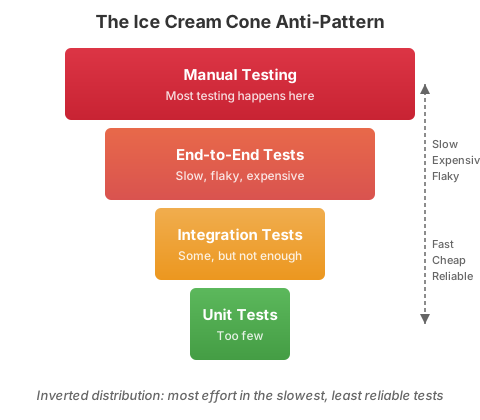
Most teams that struggle with CD have inverted the pyramid - too many slow, flaky end-to-end tests and too few fast, focused ones. Manual gates block every release. The pipeline cannot give a fast, reliable answer, so deployments become high-ceremony events.
Test Architecture
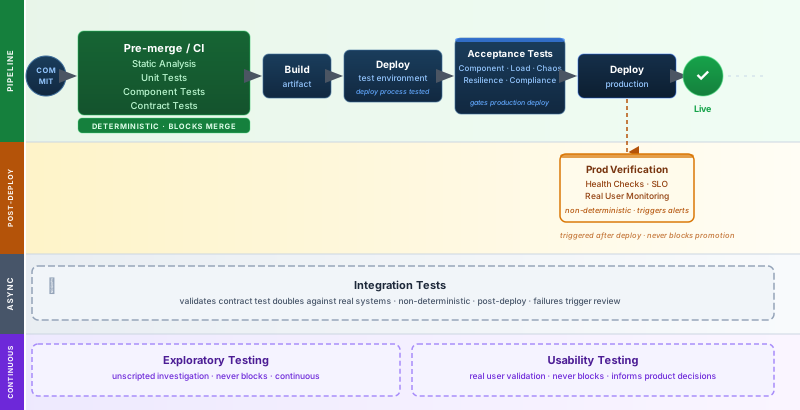
A test architecture is the deliberate structure of how different test types work together across your pipeline to give you deployment confidence. Use the table below to decide what type of test to write and where it runs. This is not a comprehensive list. It shows how common tests impact pipeline design and how teams should structure their suites. See the Pipeline Reference Architecture for a complete quality gate sequence.
| Pipeline Stage | What You Need to Verify | Test Type | Speed | Deterministic? | Blocks Deploy? |
|---|---|---|---|---|---|
| CI | A function or method behaves correctly | Unit | Milliseconds | Yes | ■ Yes |
| CI | A complete component or service works through its public interface | Component | Milliseconds to seconds | Yes | ■ Yes |
| CI | Your code correctly interacts with external system interfaces | Contract | Milliseconds to seconds | Yes | ■ Yes |
| CI | Code quality, security, and style compliance | Static Analysis | Seconds | Yes | ■ Yes |
| CI | UI meets WCAG accessibility standards | Static Analysis + Component | Seconds | Yes | ■ Yes |
| Acceptance Testing | Deployed artifact meets acceptance criteria | Deploy, Smoke, Load, Resilience, Compliance, etc. | Minutes | No | ■ Yes - gates production |
| Post-deploy (production) | Critical user journeys work in production | E2E smoke | Seconds to minutes | No | No - triggers rollback |
| Post-deploy (production) | Production health and SLOs | Synthetic monitoring | Continuous | No | No - triggers alerts |
| On demand/scheduled | Contract test doubles still match real external systems | Integration | Seconds to minutes | No | No - triggers review |
| Continuous | Unexpected behavior, edge cases, real-world workflows | Exploratory Testing | Varies | No | Never |
| Continuous | Real users can accomplish goals effectively | Usability Testing | Varies | No | Never |
The critical insight: everything that blocks merge is deterministic and under your control. Acceptance tests gate production promotion after verifying the deployed artifact. Everything that involves real external systems runs post-deployment. This is what gives you the independence to deploy any time, regardless of the state of the world around you.
Acceptance tests can include non-deterministic activities (load, chaos, resilience), but the gate decision is still deterministic: it fires on a documented pass/fail threshold - a performance budget, an error-rate ceiling, a required compliance check - not on the raw variability of the measurement. That is different from gating on a flaky test whose pass/fail flips for reasons unrelated to the change, which the Do Not list below warns against.
Pre-merge vs post-merge
The table maps to two distinct phases of your pipeline, each with different goals and constraints.
Pre-merge (before code lands on trunk): Run unit, component, and contract tests. These must all be deterministic and fast. Target: under 10 minutes total. This is the quality gate that every change must pass. If pre-merge tests are slow, developers batch up changes or skip local runs, both of which undermine continuous integration.
Post-merge (after code lands on trunk, before or after deployment): Re-run the full deterministic suite against the integrated trunk. Then run acceptance tests, E2E smoke tests, and synthetic monitoring post-deploy. Integration tests run separately in a test environment, on demand or on a schedule. Target: under 60 minutes for the full post-merge cycle.
Why re-run pre-merge tests post-merge? Two changes can each pass pre-merge independently but conflict when combined on trunk. The post-merge run catches these integration effects.
If a post-merge failure occurs, the team fixes it immediately. Trunk must always be releasable.
This post-merge re-run is what teams traditionally call regression testing: running all previous tests against the current artifact to confirm that existing behavior still works after a change. In CD, regression testing is not a separate test type or a special suite. Every test in the pipeline is a regression test. The deterministic suite runs on every commit, and the full suite runs post-merge. A green run means the artifact has been regression-tested against every behavior the suite encodes - no more and no less, which is why the suite’s coverage of prior behavior is what makes the signal trustworthy.
good practices
Do
- Run tests on every commit. If tests do not run automatically, they will be skipped.
- Keep the deterministic suite under 10 minutes. If it is slower, developers will stop running it locally.
- Fix broken tests immediately. A broken test is equivalent to a broken build.
- Delete tests that do not provide value. A test that never fails and tests trivial behavior is maintenance cost with no benefit.
- Test behavior, not implementation. Use a
black box approach - verify what the code
does, not how it does it. As Ham Vocke advises: “if I enter values
xandy, will the result bez?” - not the sequence of internal calls that producez. Avoid white box testing that asserts on internals. - Use test doubles for external dependencies. Your deterministic tests should run without network access to external systems.
- Validate test doubles with contract tests. Test doubles that drift from reality give false confidence.
- Treat test code as production code. Give it the same care, review, and refactoring attention.
- Run automated accessibility checks on every commit. WCAG compliance scans are fast, deterministic, and catch violations that are invisible to sighted developers. Treat them like security scans: automate the detectable rules and reserve manual review for subjective judgment. See Accessibility testing for the full three-tier strategy and pipeline placement.
Do Not
- Do not tolerate flaky tests. Quarantine or delete them immediately.
- Do not gate your pipeline on flaky, non-deterministic test signals. E2E and integration test failures - pass/fail that flips for reasons unrelated to the change - should trigger review or alerts, not block deployment. (An acceptance gate that fires on a deterministic threshold, like a performance budget, is not this: the gate decision is stable even when the underlying measurement varies.)
- Do not couple your deployment to external system availability. If a third-party API being down prevents you from deploying, your test architecture has a critical gap.
- Do not write tests after the fact as a checkbox exercise. Tests written without understanding the behavior they verify add noise, not value.
- Do not test private methods directly. Test the public interface; private methods are tested indirectly.
- Do not share mutable state between tests. Each test should set up and tear down its own state.
- Do not use sleep/wait for timing-dependent tests. Use explicit waits, polling, or event-driven assertions.
- Do not let unit or component tests depend on a shared or external database or service. A real engine the team controls and isolates per test - a per-test testcontainer, or a transaction that rolls back at teardown - is fine in-band and stays deterministic. A shared, mutable database, or any service the team does not control, is not: that reintroduces non-determinism, so categorize the test as integration or end-to-end and run it post-deployment, not as a pre-merge gate.
- Do not make exploratory or usability testing a release gate. These activities are continuous and inform product direction; they are not a pass/fail checkpoint before deployment.
Related Content
- ACD - How acceptance criteria make testing the constraint that governs agent-generated code
- Testing Fundamentals - Establishing testing practices as part of CD migration
- High Coverage but Ineffective Tests - When tests pass but do not catch real defects
Additional concepts drawn from Ham Vocke, The Practical Test Pyramid, and Toby Clemson, Testing Strategies in a Microservice Architecture.