Unit Tests
Fast, deterministic tests that verify a unit of behavior through its public interface, asserting on what the code does rather than how it works.
7 minute read
A reliable test suite is essential for continuous delivery. This page describes the test architecture that gives your pipeline the confidence to deploy any change - even when dependencies outside your control are unavailable. The child pages cover each test type in detail.
The test pyramid - many unit tests at the base, fewer integration tests in the middle, a handful of end-to-end tests at the top - has been the dominant mental model for test strategy since Mike Cohn introduced it. The core insight is sound: push testing as low as possible. Lower-level tests are faster, more deterministic, and cheaper to maintain. Higher-level tests are slower, more brittle, and more expensive.
But as a prescriptive model, the pyramid is overly simplistic. Teams that treat it as a rigid ratio end up in unproductive debates about whether they have “too many” integration tests or “not enough” unit tests. The shape of your test distribution matters far less than whether your tests, taken together, give you the confidence to deploy.
The pyramid’s principle - write tests with different granularity - remains correct. But for CD, the question is not “do we have the right pyramid shape?” The question is:
Can our pipeline determine that a change is safe to deploy without depending on any system we do not control?
This reframes the testing conversation. Instead of counting tests by type and trying to match a diagram, you design a test architecture where:
Fast, deterministic tests catch the vast majority of defects and run on every commit. These tests use test doubles for anything outside the team’s control. They give you a reliable go/no-go signal in minutes.
Contract tests verify that your test doubles still match reality. They run asynchronously and catch drift between your assumptions and the real world - without blocking your pipeline.
A small number of non-deterministic tests validate that the fully integrated system works. These run post-deployment and provide monitoring, not gating.
This structure means your pipeline can confidently say “yes, deploy this” even if a downstream API is having an outage, a third-party service is slow, or a partner team hasn’t deployed their latest changes yet. Your ability to deliver is decoupled from the reliability of systems you do not own.
Most teams that struggle with CD have an inverted test distribution - too many slow, expensive end-to-end tests and too few fast, focused tests.
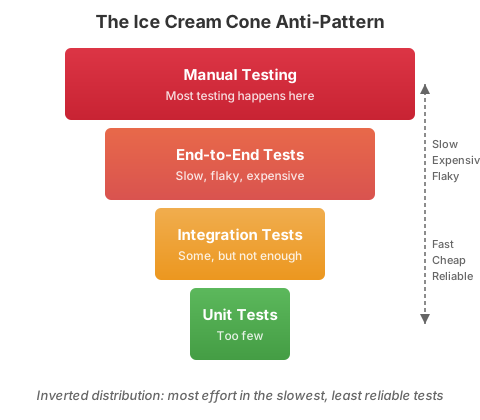
The ice cream cone makes CD impossible. Manual testing gates block every release. End-to-end tests take hours, fail randomly, and depend on external systems being healthy. The pipeline cannot give a fast, reliable answer about deployability, so deployments become high-ceremony events.
A test architecture is the deliberate structure of how different test types work together across your pipeline to give you deployment confidence. Each layer has a specific role, and the layers reinforce each other.
| Layer | Test Type | Role | Deterministic? | Details |
|---|---|---|---|---|
| 1 | Unit Tests | Verify behavior in isolation - catch logic errors, regressions, and edge cases instantly | Yes | Fastest feedback loop; use test doubles for external dependencies |
| 2 | Integration Tests | Verify boundaries - catch mismatched interfaces, serialization errors, query bugs | Yes | Fast enough to run on every commit |
| 3 | Functional Tests | Verify your system works as a complete unit in isolation | Yes | Proves the system handles interactions correctly with all external dependencies stubbed |
| 4 | Contract Tests | Verify your test doubles still match reality | No | Runs asynchronously; failures trigger review, not pipeline blocks |
| 5 | End-to-End Tests | Verify complete user journeys through the fully integrated system | No | Monitoring, not gating - runs post-deployment |
Static Analysis runs alongside layers 1-3, catching code quality, security, and style issues without executing the code. Test Doubles are used throughout layers 1-3 to isolate external dependencies.
The critical insight: everything that blocks deployment is deterministic and under your control. Everything that involves external systems runs asynchronously or post-deployment. This is what gives you the independence to deploy any time, regardless of the state of the world around you.
The table above maps to two distinct phases of your pipeline, each with different goals and constraints.
Pre-merge (before code lands on trunk): Run unit, integration, and functional tests. These must all be deterministic and fast. Target: under 10 minutes total. This is the quality gate that every change must pass. If pre-merge tests are slow, developers batch up changes or skip local runs, both of which undermine continuous integration.
Post-merge (after code lands on trunk, before or after deployment): Re-run the full deterministic suite against the integrated trunk to catch merge-order interactions. Run contract tests, E2E smoke tests, and synthetic monitoring. Target: under 30 minutes for the full post-merge cycle.
Why re-run pre-merge tests post-merge? Two changes can each pass pre-merge independently but conflict when combined on trunk. The post-merge run catches these integration effects. If a post-merge failure occurs, the team fixes it immediately - trunk must always be releasable.
Use this reference to decide what type of test to write and where it runs in your pipeline.
| What You Need to Verify | Test Type | Speed | Deterministic? | Blocks Deploy? |
|---|---|---|---|---|
| A function or method behaves correctly | Unit | Milliseconds | Yes | Yes |
| Components interact correctly at a boundary | Integration | Milliseconds to seconds | Yes | Yes |
| Your whole service works in isolation | Functional | Seconds | Yes | Yes |
| Your test doubles match reality | Contract | Seconds | No | No |
| A critical user journey works end-to-end | E2E | Minutes | No | No |
| Code quality, security, and style compliance | Static Analysis | Seconds | Yes | Yes |
| UI meets WCAG accessibility standards | Static Analysis + Functional | Seconds | Yes | Yes |
x and y, will the
result be z?” - not the sequence of internal calls that produce z. Avoid
white box testing that asserts on internals.| Type | Purpose |
|---|---|
| Unit Tests | Verify individual components in isolation |
| Integration Tests | Verify components work together |
| Functional Tests | Verify user-facing behavior |
| End-to-End Tests | Verify complete user workflows |
| Contract Tests | Verify API contracts between services |
| Static Analysis | Catch issues without running code |
| Test Doubles | Patterns for isolating dependencies in tests |
| Feedback Speed | Why test suite speed matters and the cognitive science behind the targets |
Content contributed by Dojo Consortium, licensed under CC BY 4.0. Additional concepts drawn from Ham Vocke, The Practical Test Pyramid, and Toby Clemson, Testing Strategies in a Microservice Architecture.
Fast, deterministic tests that verify a unit of behavior through its public interface, asserting on what the code does rather than how it works.
Deterministic tests that verify how units interact together or with external system boundaries using test doubles for non-deterministic dependencies.
Deterministic tests that verify all modules of a sub-system work together from the actor’s perspective, using test doubles for external dependencies.
Non-deterministic tests that validate the entire software system along with its integration with external interfaces and production-like scenarios.
Non-deterministic tests that validate test doubles by verifying API contract format against live external systems.
Code analysis tools that evaluate non-running code for security vulnerabilities, complexity, and best practice violations.
Patterns for isolating dependencies in tests: stubs, mocks, fakes, spies, and dummies.
Why test suite speed matters for developer effectiveness and how cognitive limits set the targets.
Definitions for testing terms as they are used on this site.