Test Automation Always Lags Behind Development
4 minute read
What you are seeing
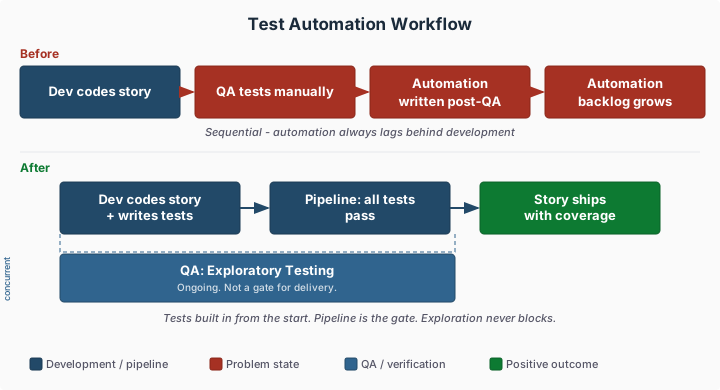
Development completes a user story. It moves to QA. A QA engineer manually tests it, finds issues, they get fixed, and QA re-tests. Once manual testing passes, someone writes automated tests based on what QA verified. By then, development is three stories further along. The automation backlog never shrinks because the process guarantees it will always be one sprint behind.
Teams in this situation often wonder whether AI can close the gap by generating tests from requirements. AI tools can scaffold test cases from acceptance criteria, and that can reduce the time it takes to write automation. But if the process still sequences automation after manual QA sign-off, the lag persists. The bottleneck is structural. Automation that arrives after manual testing adds cost without adding speed.
A subtler problem is that automation written from manual QA results tends to encode what testers happened to check rather than what the requirements demand. Edge cases not discovered during manual testing remain uncovered in automation. The test suite grows to confirm what the team already knows, not to catch what it does not know yet.
Workflow comparison
Common causes
Testing only at the end
When testing is a phase that begins after development is marked complete, automation inherits that sequencing. Developers hand work to QA. QA validates it manually. Automation follows. There is no structural point in the workflow where automated tests are expected before the story ships. The lag is not a failure of discipline. It is the natural output of a process that positions testing downstream of development.
Shifting automation earlier requires treating automated tests as a delivery requirement, not a follow-up activity. Stories are not complete until automated tests exist and pass. Developers write or contribute to those tests as part of finishing the work. Manual QA shifts from primary verification to exploratory testing, catching edge cases the automated suite does not cover.
Read more: Testing Only at the End
Siloed QA team
When a separate QA team owns both manual testing and test automation, developers have no role in either. Developers write code; QA writes tests. The division feels natural (testing is QA’s job), but it means the team most familiar with implementation details is not writing the tests. QA automation engineers are translating manual test results into code rather than working from source knowledge of the system.
When developers share responsibility for automated tests, automation can be written as code is written. A QA engineer reviewing a story during development can identify what needs automated coverage. A developer finishing a feature can write the corresponding unit and integration tests. The handoff that creates the lag disappears because there is no handoff.
Read more: Siloed QA Team
Manual testing only
When manual testing is the established quality gate, automated testing is treated as an enhancement rather than a requirement. Automation is written when time permits, which means it is written after the work that is required. The team talks about eliminating manual testing but the delivery process does not enforce automated test coverage, so manual testing remains the gate and automation remains optional.
Making automated test coverage a hard requirement (nothing ships without it) reorders the priorities. The question changes from “will we have time to automate this?” to “what automated tests does this story require?” Manual testing does not disappear, but it becomes the secondary layer rather than the primary one.
Read more: Manual Testing Only
How to narrow it down
- Is there a step in your workflow where a story moves from “dev complete” to “QA”? If work travels from developers to a separate QA queue before automated tests are written, the process is sequencing automation after manual testing by design. Start with Testing Only at the End.
- Do developers write automated tests for their own stories, or does a separate team write them? If automation is QA’s responsibility, developers are structurally excluded from the activity that could close the lag. Start with Siloed QA Team.
- Can a story ship without automated test coverage? If manual QA sign-off is sufficient to release, automation will be deferred whenever time is short, which is often. Start with Manual Testing Only.
Ready to fix this? The most common cause is Testing Only at the End. Start with its How to Fix It section for week-by-week steps.