End-to-End Tests
5 minute read
Definition
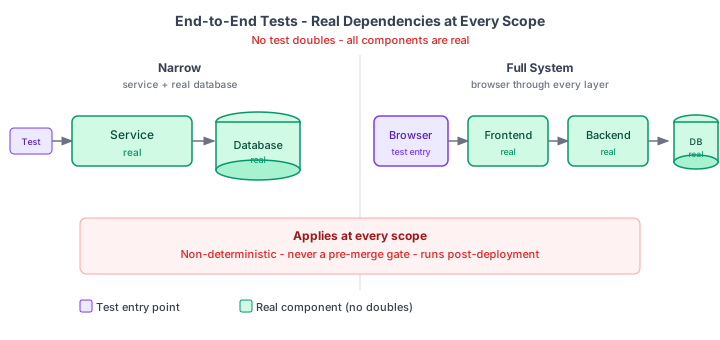
An end-to-end test exercises real components working together - no test doubles replace the dependencies under test. The scope ranges from two services calling each other, to a service talking to a real database, to a complete user journey through every layer of the system.
The defining characteristic is that real external dependencies are present: actual databases, live downstream services, real message brokers, or third-party APIs. Because those dependencies introduce timing, state, and availability factors outside the test’s control, end-to-end tests are typically non-deterministic. They fail for reasons unrelated to code correctness - network instability, service unavailability, test data collisions, or third-party rate limits.
Terminology note
“Integration test” and “end-to-end test” are often used interchangeably in the industry. Martin Fowler distinguishes between narrow integration tests (which use test doubles at the boundary - what this site calls contract tests) and broad integration tests (which use real dependencies). This site treats them as distinct categories: integration tests validate that contract test doubles still match the real external systems, while end-to-end tests exercise user journeys or multi-service flows through real systems.
Scope
End-to-end tests cover a spectrum based on how many components are real:
| Scope | Example |
|---|---|
| Narrow | A service making real calls to a real database |
| Service-to-service | Order service calling the real inventory service |
| Multi-service | A user journey spanning three live services |
| Full system | A browser test through a staging environment with all dependencies live |
All of these involve real external dependencies. All share the same fundamental non-determinism risk. Use the narrowest scope that gives you the confidence you need.
When to Use
Use end-to-end tests sparingly. They are the most expensive test type to write, run, and maintain. Use them for:
- Smoke testing a deployed environment to verify that key integrations are functioning after a deployment.
- Happy-path validation of critical business flows that cannot be verified any other way (e.g., a payment flow that depends on a real payment provider).
- Cross-team workflows that span multiple deployables and cannot be isolated within a single component test.
Do not use end-to-end tests to cover edge cases, error handling, or input validation. Those scenarios belong in unit or component tests, which are faster, cheaper, and deterministic.
Vertical vs. horizontal
Vertical end-to-end tests target features owned by a single team:
- An order is created and the confirmation email is sent.
- A user uploads a file and it appears in their document list.
Horizontal end-to-end tests span multiple teams:
- A user navigates from homepage through search, product detail, cart, and checkout.
Horizontal tests have a large failure surface and are significantly more fragile. They are not suitable for blocking the pipeline; run them on a schedule and review failures out of band.
Characteristics
| Property | Value |
|---|---|
| Speed | Seconds to minutes per test |
| Determinism | Typically non-deterministic |
| Scope | Two or more real components, up to the full system |
| Dependencies | Real services, databases, brokers, third-party APIs |
| Network | Full network access |
| Database | Live databases |
| Breaks build | No - triggers review or rollback, not a pre-merge gate |
Examples
A narrow end-to-end test verifying a service against a real database:
A full-system browser test using a browser automation framework:
Anti-Patterns
- Using end-to-end tests as the primary safety net: this is the ice cream cone anti-pattern. The majority of your confidence should come from unit and component tests, which are fast and deterministic. End-to-end tests are expensive insurance for the gaps.
- Blocking the pipeline: end-to-end tests must never be a pre-merge gate. Their non-determinism will eventually block a deploy for reasons unrelated to code quality.
- Blocking on horizontal tests: horizontal tests span too many teams and failure surfaces. Run them on a schedule and review failures as a team.
- Ignoring flaky failures: track frequency and root cause. A test that fails for environmental reasons is not providing a code quality signal - fix it or remove it.
- Testing edge cases here: exhaustive permutation testing in end-to-end tests is slow, expensive, and duplicates what unit and component tests should cover.
- Not capturing failure context: end-to-end failures are expensive to debug. Capture screenshots, network logs, and video recordings automatically on failure.
Connection to CD Pipeline
End-to-end tests run after deployment, not before:
A team may choose to gate on a small, highly reliable set of vertical end-to-end smoke tests immediately after deployment. This is acceptable only if the team invests in keeping those tests stable. A flaky smoke gate is worse than no gate: it trains developers to ignore failures.
Use contract tests to verify that the test doubles in your component tests still match reality. This gives you deterministic pre-merge confidence without depending on live external systems.